I've been practicing yoga since 2011. And since becoming a chiropractor, I attend classes with a sort of... double lookI'm on my mat like everyone else, trying not to fall in Warrior III, and at the same time I can't help but look at everything with the eyes of a movement professional.
Especially the small details. Those things the teacher mentions in passing, that you apply without thinking, and that have been around for centuries for a reason. Yoga understood many of these things long before modern biomechanics existed.
I'll tell you four.
1. The look, or how your neck moves out of its usual range
It's one of the details that fascinates me the most, personally.
In many poses you are asked to look towards a specific point. The thumb in Warrior II. The top hand in Trikonasana, etc.
We usually understand it as something that requires concentration, and it is. But when you look upwards or diagonally, the head accompanies. And there you are, moving your neck in ranges you probably don't visit all day.
Think about how you spend your time: screen in front of you, phone down below, and little else. Your neck is almost always straight or tilted downwards.
Looking upwards and diagonally works all the muscles that support the head from behind.. And that's precisely what prevents us from ending up with our head sticking forward, like a shrimp. For posture, it's one of the best things you can do.

2. The foot tripod, or where your posture really begins
When they tell you to "distribute your weight across the three points of your foot," it's not a minor detail!
Your feet are the only thing touching the ground. Everything that happens down there rises: knees, hips, pelvis, spine. If the weight shifts all inwards or all outwards, the rest of the chain is organized around that.
In addition, the sole of the foot is full of receptors proprioception. These are sensors that tell your brain, in real time, where your body is in space. The better the information they receive, the better everything else can be organized.
Therefore, if you focus on the "tripod," the work changes in all postures, not just the balancing ones. A well-executed Tadasana is not a resting pose!
On the other hand: you go barefoot in class. Most of the day our feet are enclosed in narrow shoes, Without being able to move. On the mat, your toes can spread, grip, and participate. You use your whole foot.
This is also one of the reasons why I'm so interested in barefoot footwear. If you're curious, I wrote about it. the connection between the feet, posture and spine on my blog.
3. Going to the ground, or the movements we stop doing
As adults, we stop going down to the floor. We sit in chairs, on sofas, on the subway. And little by little, the body stops exploring full positions: squatting, lying face down, turning onto one side, getting up from the floor without support.
What is not used, is lost. Not all at once, but it is lost.
And this isn't about striking pretty poses. It's about being able to play with your children on the floor, bending down to pick something up without thinking, getting out of the car without having to search for something to put your hand on. Things we take for granted until they aren't.
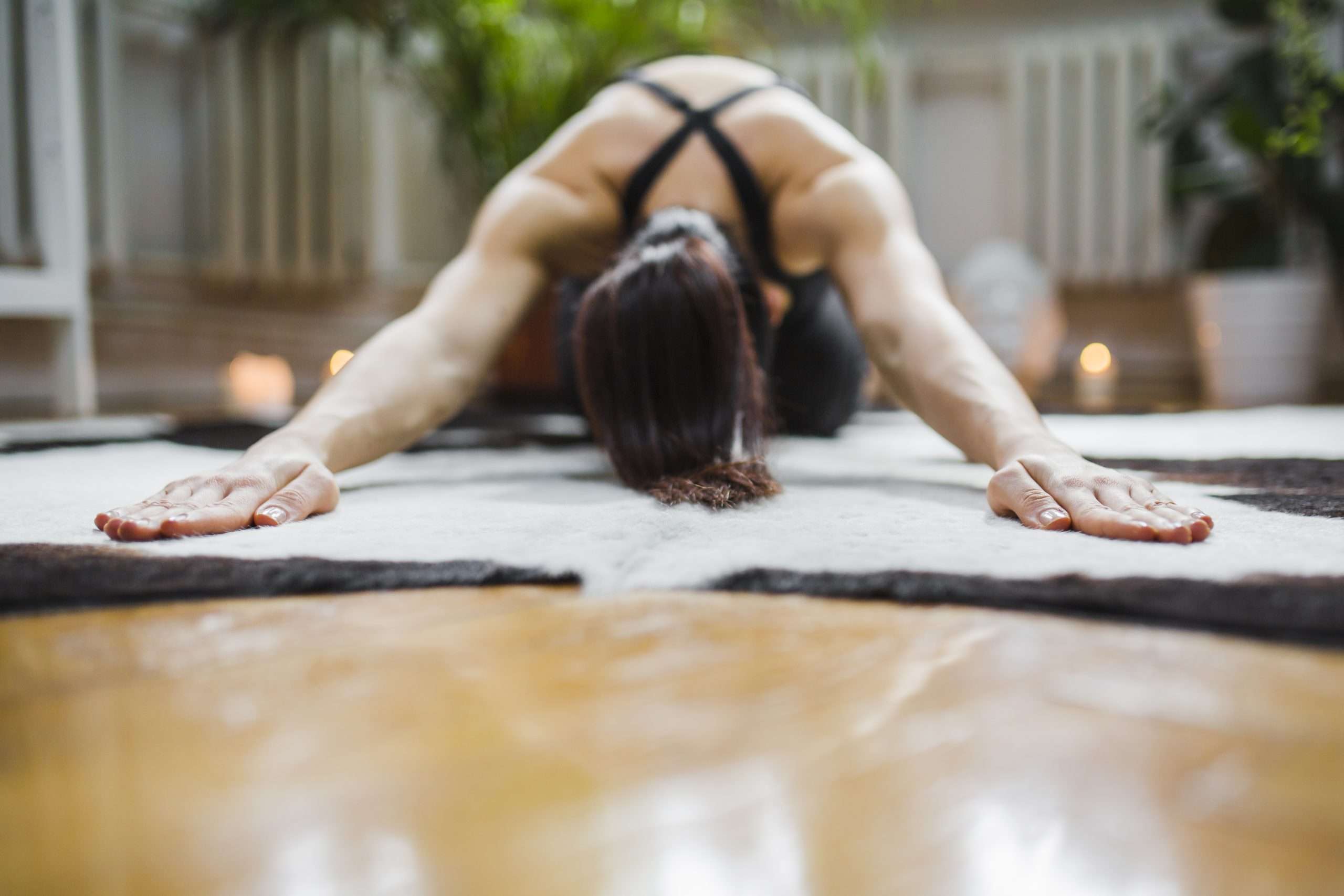
Yoga is one of the few things that regularly brings you back there. You go down, you twist, you lie down, you get up. You explore full ranges, one side and then the other, and along the way you find out that your right hip doesn't do the same thing as your left.
And there's something I find more valuable than flexibility: curiosity. Observing without judgment. Taking note of how your body feels today, without making a problem of it.
If you spend many hours sitting down every day, These 5 postures to practice at work They are a good way to break the pattern.
4. The diaphragm, or why you come out different from a class
I spend my days telling people who come to my office that they don't know how to breathe. They always find it funny. And then I explain what the diaphragm is. It's not just a respiratory muscle.. It is also a postural muscle, and is directly related to the nervous system for relaxation.
In the traditional chinese medicine, Furthermore, the diaphragm is understood as the boundary between the upper and lower parts of the body, and as a point of key step for energy between the two.
But true, When you breathe short and high, towards your chest, your body is usually in alert mode. When breathing slows down and the abdomen moves, the nervous system tends to follow, moving towards a calmer state.
If you want to learn more, they have an article about it. breathing techniques in yoga which goes hand in hand with this.
That's why a class can leave you feeling different when you leave.
And here's the part that interests me as a chiropractor: posture is, to a large extent, a reflection of the state of the nervous system. A body under constant tension organizes itself in one way. A body that can reduce its revolutions organizes itself in another.
And in fact, this is basically what my job is about. The spine protects the spinal cord., which is the main communication pathway between your brain and the rest of your body. When that structure moves well, the nervous system functions better. When areas have been blocked for a long time, the body organizes itself around that, and it ends up showing in posture, breathing, and how you manage stress.
The spine and the nervous system are one and the same. Yoga enters through movement and breath. I enter through the joints. In the end, we arrive at the same place.

In summary
None of this is magic, but it's simply that yoga makes you do, in a fairly systematic way, things that your daily life has taken away from you.
And there is a fifth one that is no small matter: an hour without a mobile phone, No notifications, no one messaging you. These days, that's practically a luxury!
All of that, repeated week after week, adds up.
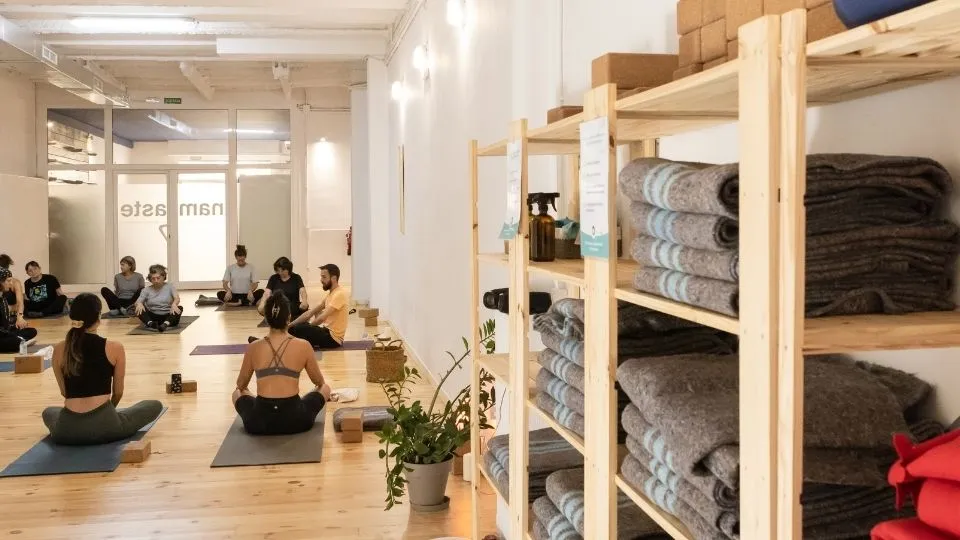
See you on the mat at Sincronia. I usually wear toe separators during practice, so I'm easy to spot! :)
Léa Salgado is Chiropractic in Barcelona She lives at C/ Pau Claris 153 and has been practicing yoga since 2011. She writes about posture, movement, and the nervous system in Read Chiropractic